Category: Tabletop Wisdom

  • You Can’t Lead by Sucking the Joy Out of the Room: A TTRPG Guide to Negative Leadership

    You Can’t Lead by Sucking the Joy Out of the Room: A TTRPG Guide to Negative Leadership

    There’s a particular kind of emotional exhaustion that settles in when your Game Master thinks being in charge means being right all the time. It starts slow–your character’s little backstory never gets acknowledged, your clever ideas get waved off with a smirk and a house rule, and pretty soon you’re just rolling dice and getting your turn over with as little friction as possible. You used to be excited to play. Now you’re mostly just tracking hit points and trying to survive the session. It’s not that you don’t like the game. It’s that the person running it has made the table feel like a minefield. 

    I’ve had day jobs that feel exactly like that. 

    What I call Negative Leadership shows up in real life the same way it shows up in bad tabletop campaigns. It’s not always loud or theatrical. It’s a mindset. A controlling, defensive, brittle approach to being in charge. It’s the manager who talks like a GM who’s memorized every line of the module but hasn’t noticed that half the players are disengaged. They think “leadership” means quoting the rulebook and punishing deviation. They treat innovation like it’s cheating and feedback like it’s a charisma check they can refuse. 

    I’ve worked across a bunch of different environments–logistics, operations, customer service–and while the industries changed, the vibe of a bad manager never did. You try to bring something to the table, and they act like you’re violating canon. I once stayed late to help a new hire finish up a shipment–just helping out. Next day, I get pulled aside for “disrupting the process.” In another job, a manager pinned dollar bills to his office wall from bets he won against his own staff, like we were all stuck in some sad, corporate version of Tomb of Horrors. Nobody said anything, but we all saw the message: this place runs on ego checks. 

    What makes it harder is that most of these leaders don’t see themselves as the problem. They think they’re enforcing standards. That they’re the only thing holding back the chaos. But treating your team like a bunch of unruly NPCs doesn’t build order–it builds resentment. Calling someone “not great with people” doesn’t begin to cover it. It’s more like they see empathy as a homebrew mechanic they don’t trust. 

    Frederick Herzberg’s Motivation-Hygiene Theory puts a fine point on it: the stuff that demotivates people isn’t the same stuff that inspires them. You can have health benefits, free snacks, and an end-of-week XP bonus, but if your boss treats you like a barely tolerated raccoon who wandered into the breakroom–something to be monitored and controlled–you’re not going to stay motivated. You’ll stick around, maybe, but your heart won’t be in it. It’s like showing up to a dungeon crawl where the GM never lets you explore. You’re not playing–you’re just rolling to comply.

    And like any bad GM, the truly corrosive managers rarely blow up in obvious ways. It’s not all dramatic yelling or slamming doors. It’s a slow bleed: a joke that lands too hard, a change in protocol with no explanation, a public correction that wasn’t necessary. I once got called out for parking a training vehicle “the wrong way,” even though it was the safest available option. The response wasn’t, “Let’s talk through it.” It was, “Rules are rules.” No context, no conversation. Just pure authoritarian DM energy. 

    Douglas McGregor’s Theory X and Theory Y explains this kind of behavior. Theory X leaders believe that people are fundamentally lazy and need to be coerced into productivity. So they act like GMs who run every session like a power fantasy–one where players can’t be trusted to make good decisions, so every path is railroaded and every choice is an illusion. And when the team stops engaging, these managers see it as proof. “See? They only work when I’m watching.” Yes, because you’ve made watching feel like surveillance, not support. 

    The wild part is, I came into all those jobs wanting to contribute. I had ideas. I saw things that could be improved. I wanted to play the game well, not break it. But when your every move gets treated like a challenge to the GM’s authority, you eventually just stop rolling. Not because you don’t care, but because the consequences for trying feel too steep. 

    The worst leadership I’ve experienced didn’t look dramatic. It looked polite. Measured. Controlled. And deeply suffocating. You could ask questions, sure–but only once. And only if they were easy. The mood in the room said: Don’t make waves. It’s the difference between a campaign where the players feel powerful and one where they feel watched. Some leaders don’t know the difference. 

    What makes it worse is that these kinds of leaders often believe they’re respected. What they’re actually seeing is compliance dressed up as loyalty. It’s players nodding at the table because they’ve learned what happens if they don’t. Google’s Project Aristotle found that the most successful teams aren’t built on competence alone. They’re built on psychological safety–on people knowing they can speak up without getting wrecked by an attack of opportunity. Negative Leadership squashes that before the first session’s even over. 

    So what’s the fix? It’s not handing over the GM screen to chaos. It’s leading like someone who actually wants the party to succeed. Bernard Bass called this transformational leadership: building people up, not boxing them in. Sharing the story. Listening to the table. Trusting your team to be more than background flavor. 

    And here’s the kicker–any of us can drift into Negative Leadership if we’re not careful. All it takes is a little pressure, a little stress, and a little too much certainty. Suddenly, you’re making decisions to protect your own authority instead of supporting the people at the table. You’re no longer the GM guiding the story–you’re the final boss in someone else’s burnout narrative. 

    Leadership isn’t about being the smartest person in the room or holding the most lore. It’s about making the session better because you were there. If people feel freer, braver, and more creative when you’re gone, you’re not leading–you’re just running a game they can’t wait to finish. 

    And no one brags about surviving that campaign.
  • The Most Toxic Alignment at the Table: Chaotic Selfish

    The Most Toxic Alignment at the Table: Chaotic Selfish

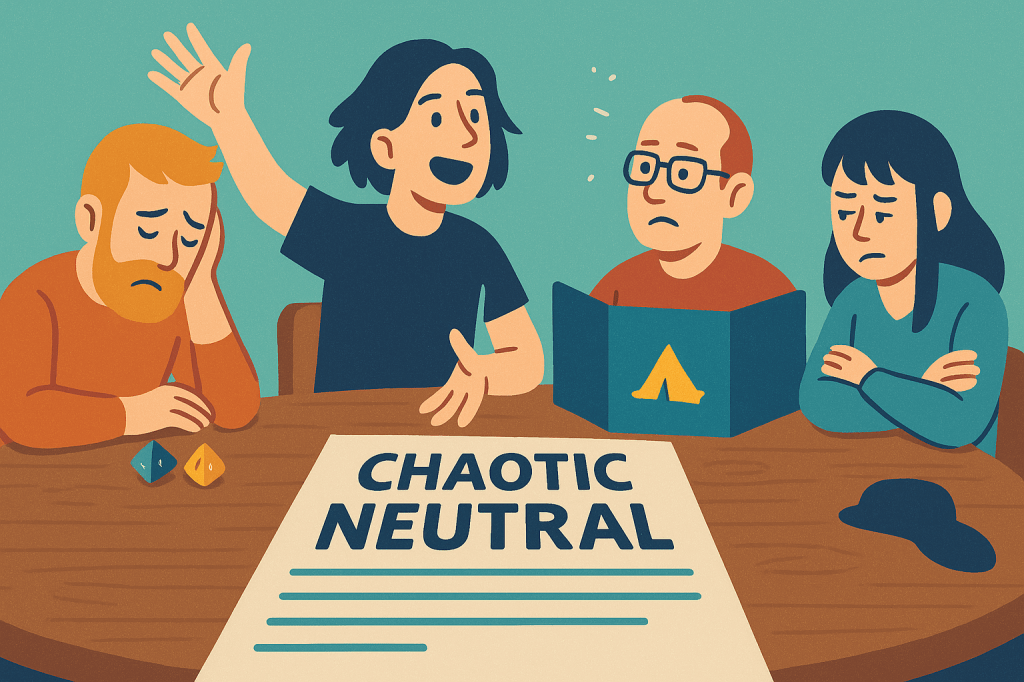
    There’s a certain kind of player who shows up to your game table and, within five minutes, makes it clear that they’re “Chaotic Neutral.” Not just in character sheet alignment, but in the very marrow of their bones. You can smell it on them like Axe body spray and misplaced confidence. They say it with a grin, usually while licking a dagger or attempting to steal from the party’s healer. They believe this gives them permission to act entirely on impulse, with no consideration for the rest of the group or the broader story. They will gleefully derail entire plot arcs, antagonize NPCs for no reason, betray the party for a shiny trinket, and defend it all with one sacred phrase: “I’m just playing my character.”

    And if you’re lucky, they’ll do it before you’ve printed everyone’s Session Zero handouts.

    Now, let’s not misunderstand the assignment. Chaotic Neutral as an alignment isn’t inherently broken. In fact, when played with nuance, it can be one of the most textured roles at the table. These characters are wild cards, but they should still have values—they might reject laws, but not consequences; they might be unpredictable, but not purposeless. The problem is that, more often than not, what we’re dealing with isn’t Chaotic Neutral. It’s something much worse: Chaotic Selfish. It’s a player who confuses impulsiveness with entitlement. A player who believes that because they have chosen to act like a gremlin, the group is now obligated to revolve around that behavior or risk “ruining the fun.” It’s not a character flaw they’ve built into their backstory—it’s a leadership vacuum they’ve dragged in from real life.

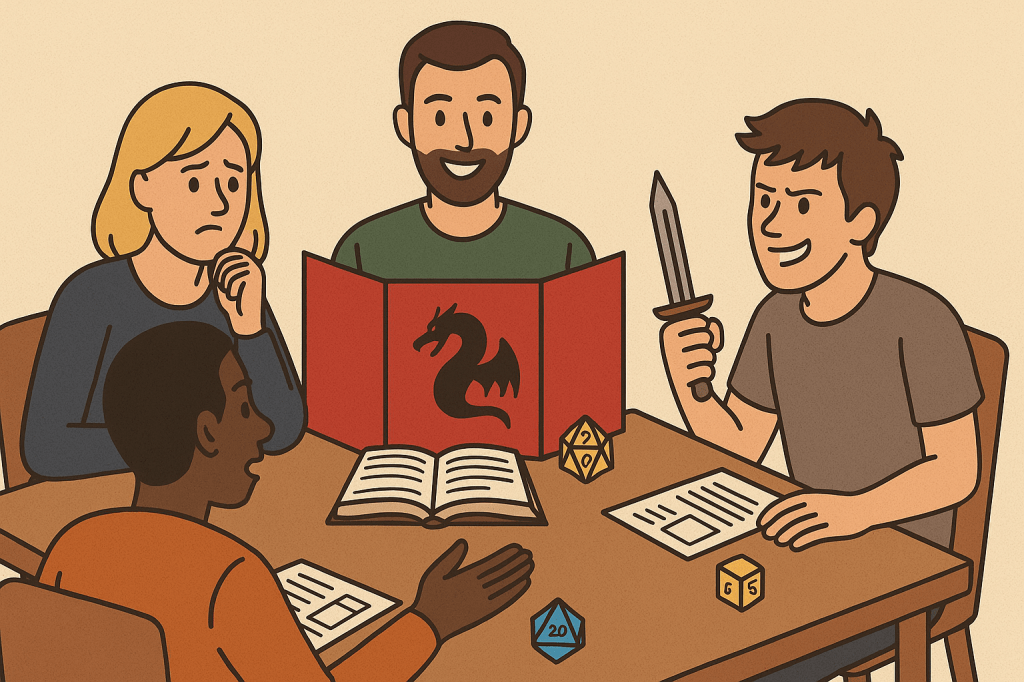
    This is where the leadership lesson kicks in with a steel-toed boot. Every GM is a de facto leader, whether they asked for it or not. You’re not just managing a story—you’re managing a group of people, each of whom has different motivations, energy levels, social cues, and expectations about what a “fun” game night looks like. And one of the most insidious leadership traps you’ll fall into is thinking that everyone in the group is here to play the same game. They’re not. One player might want a deep character arc and emotional growth. Another is here to unwind after work by punching ghosts. A third thinks they’re auditioning for Critical Role, and a fourth just wants to do math with fireballs. If your Chaotic Selfish player isn’t corrected early, they will fracture that group like a bad manager who mistakes “disruption” for innovation.

    Because here’s the uncomfortable truth most leadership books won’t tell you: not all conflict is healthy. Yes, diversity of thought is valuable. Yes, challenging the status quo can drive innovation. But when someone insists on setting fires inside the team dynamic just to watch what happens, they’re not challenging assumptions—they’re demanding attention. And when leaders tolerate that behavior under the banner of “freedom,” they’re not being inclusive; they’re abandoning the rest of the team to fend for themselves. If you’ve ever worked with someone who constantly interrupts meetings with off-topic jokes, undercuts colleagues with passive-aggressive remarks, or ignores deadlines because they “work best under pressure,” you’ve already met this person. You just called them Carl from marketing instead of Zorkas the Knife-Licker.

    The problem gets worse because many GMs, like many new managers, are conflict-avoidant. They don’t want to “ruin the vibe.” They want to be liked. And so they let the behavior slide, justifying it as flavor or roleplay. After all, isn’t the point of a tabletop RPG to allow people to do things they can’t do in real life? Sure. But there’s a difference between a fantasy of power and a fantasy of lack of consequences. One is healthy escapism; the other is what you get when you let someone live out their worst impulses in a sandbox with no boundaries. You don’t have to let it slide. You shouldn’t. Good leadership doesn’t mean letting everyone do whatever they want. It means setting a culture where everyone can thrive, not just the loudest person with a backstory written in blood.

    If you need a scholarly anchor to hang your GM screen on, let’s talk about transformational leadership, the kind that focuses on inspiring and guiding individuals toward a shared vision. Bernard Bass (1990) outlined the four components: idealized influence, inspirational motivation, intellectual stimulation, and individualized consideration. If your “chaotic” player is stifling any one of those pillars, your leadership mandate is clear—they need coaching, redirection, or, in some rare cases, a one-way ticket out of the campaign. When someone makes the game unplayable for others, that is a leadership problem, not a roleplay quirk. Letting it fester because “that’s just how they are” is the same as letting a team member steamroll meetings because “they’re just passionate.” No—they’re just inconsiderate. And inconsiderate people don’t improve by being enabled.

    There’s a reason most TTRPG safety tools—like The X-Card—exist in the first place: because the social contract of the table is fragile. Most of us are awkward nerds with damage and anxiety and jobs we’re trying to escape for three hours on a Thursday. The emotional risk of collaborative storytelling is real. So when someone shows up determined to be the unpredictable gremlin who pees in the soup and blames the character sheet, what they’re really doing is violating that social contract—and trusting you, the GM, not to call them on it.

    So call them on it.

    Do it early, do it privately, and do it with the same calm confidence you’d use to tell someone they forgot deodorant. Be direct: “I want to make sure this game is fun for everyone, and I’ve noticed that some of your character’s actions are making that harder. Can we talk about ways to channel that chaotic energy without disrupting the table?” That’s not confrontation. That’s leadership. That’s you refusing to let one person ruin a shared experience because they don’t know the difference between playing a complex character and throwing a tantrum with dice.

    Look, no group is perfect. And no GM is either. You’re going to make mistakes. You’re going to let stuff slide that you shouldn’t, or come down hard when you should’ve asked a question instead. That’s the job. That’s why they call it “running” a game—you’re always in motion, always responding, always adjusting. But you don’t have to do it with a party member standing on the roof of the tavern, throwing Molotov cocktails into your narrative because they thought it would be funny. You don’t have to let selfishness wear the mask of alignment.

    Chaotic Neutral doesn’t have to mean chaos without care. It can mean unpredictability with purpose. It can mean wildness tempered by curiosity. And most importantly, it can mean a table where everyone—not just the loudest—gets to be the main character in their own little story.

  • Most TTRPG Groups Don’t Fail Because of Bad Rules. They Fail Because Nobody Talks About What They Want.

    Most TTRPG Groups Don’t Fail Because of Bad Rules. They Fail Because Nobody Talks About What They Want.

    If you’ve ever watched a tabletop RPG group implode halfway through a campaign, odds are it didn’t happen because the rogue broke the stealth rules or someone forgot how grappling works. 

    It happened because the group never agreed on what kind of story they were telling. 

    That’s the real killer. Not bad dice rolls, not min-maxing, not even a toxic player (although that’ll do it too.) It’s mismatched expectations. One player wants a deep, interesting story where their backstory matters. Another just wants to vibe and roll for soup. A third is out here trying to trigger every combat encounter because they thought it was going to be dungeon-crawl heavy. 

    Nobody’s wrong. 

    But when nobody talks about it ahead of time, the group ends up playing three different games on the same night. And resenting each other for it. 

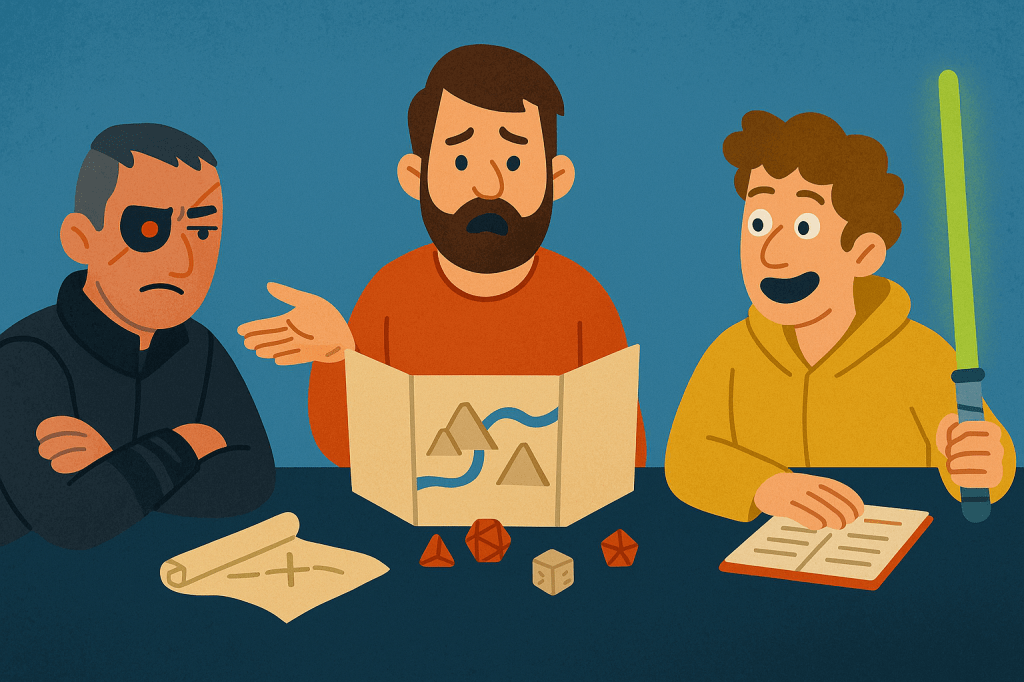
    A while back, I ran a Star Wars campaign set aboard a derelict research vessel in deep space. The tone I was going for was budget Event Horizon but everyone’s tired and no one trusts each other. No heroes. No clean uniforms. Just scavengers trying not to get pulled apart by a haunted ship with bad wiring and worse intentions. 

    The first character to show up was perfect. A burned-out salvager with a busted EVA suit and a cybernetic eye that twitched when the humidity got too high. Total grunge vibes. Paranoia baked into the character sheet. We were locked in. 

    Then came the next player.

    They introduced a rogue Jedi who was–how do I put this?–absolutely unhinged. 

    Imagine if Charlie Day got knighted by accident and now he has a lightsaber and a working knowledge of Force Push. He talked a mile a minute, stole rations from NPCs for “training,” and once used his telekinesis to hurl a toilet at a hallway camera for reasons I still don’t understand. His entire backstory hinged on being kicked out of multiple Jedi temples for “philosophical differences.”

    Now, this wasn’t a bad character. It just didn’t belong in this game. 

    By the third session, the tone was wrecked. One moment we were crawling through vent shafts trying to avoid a sentient virus, the next he was trying to telepathically convince the ship’s AI to adopt him. The salvager’s player pulled me aside, asking if I could “get things back on track.” The Jedi’s player thought they were keeping things fun

    Neither of them was wrong.
    But we never had the conversation.
    And by the time we tried, the tone whiplash had already torn the party apart.

    The game died a couple of sessions later. 

    It’s the same in leadership, by the way. 

    Small teams don’t fall apart because the spreadsheet formatting was wrong. They fall apart because no one agreed on what success looked like. No one clarified how they wanted to work together. Everyone just assumed their way was the default. 

    You have to talk about it. 

    You have to talk about tone, pacing, player buy-in, safety tools, table culture–all the boring stuff that keeps your game from catching fire three weeks in. It’s not exciting, but it’s essential. 

    Same goes for coaching.
    Same goes for management.
    Same goes for any environment where human beings are expected to collaborate and make something together. 

    If you’re leading a game–or a team–you are responsible for helping people articulate what they want. And then you’re responsible for guiding the group toward a shared direction that honors as much of that as possible. 

    Because if you don’t?

    You’ll end up with a group of well-meaning, creative, passionate people–who can’t stand playing together.

  • Your Alignment Doesn’t Excuse Your Behavior

    Your Alignment Doesn’t Excuse Your Behavior

    If you’ve ever GM’d for more than five minutes, you’ve probably heard a player say, “Hey, it’s not me doing that, it’s just what my character would do.”

    And nine times out of ten, they say it right after doing something that completely derails the game. 

    It’s the alignment excuse. “I’m Chaotic Neutral.” “I’m Lawful Evil.” “I’m just playing my character.” Like putting it on a character sheet gives them permission to act like a tornado made of red flags and questionable decisions. 

    The same thing happens in the real world. 

    People use labels like personality types, star signs, Enneagram numbers, job titles, and even trauma to explain behavior they don’t want to be accountable for. “I’m just direct.” “I have no filter.” “I’m a disruptor.” “That’s just my leadership style.” As if naming the behavior makes it untouchable. 

    But here’s the thing.
    You don’t get to avoid responsibility just because your chaos is labeled. 

    I’ve seen players blow up a session and then shrug it off because “that’s what a Chaotic Good rogue would do.” I’ve seen people in meetings steamroll their coworkers because “they’re just super Type A.” At some point, it’s not about the label. It’s about the impact. 

    And let’s be honest. Alignment is supposed to be a guide, not a get-out-of-jail-free card. 

    Your character can be Chaotic Good and still care about how their actions affect the party. Your work personality can be “bold and assertive” without making your coworkers feel like they’re in a hostage negotiation. You can be a survivor of something awful and still be expected to grow, reflect, and not inflict that same chaos on others. 

    One table I played at, a character was labeled as evil, but what they really seemed to mean was that they didn’t operate with the same moral compas as the rest of the group. They weren’t villainous, just unpredictable. Not cruel, but hard to trust. It made for some interesting dynamics, but only because the rest of the group was constantly adjusting to avoid conflict. And over time, that gets exhausting. 

    Because it’s not just about how we behave. It’s about how we expect others to bend around our behavior. Some people hid behind “chaos” because it feels safer than vulnerability. Some people lean into a villain role because it’s easier than letting the group count on them. And some people avoid being called “good” because they associate that word with people who didn’t earn it. 

    But none of that erases impact. 

    Whether you’re at the table, in a workplace, or out in the world, you don’t get to throw your hands up and say, “Well, that’s just how I am.” Not if you’re playing with others. Not if you’re leading. Not if you’re showing up in a community with real people who are trying to make things better. 

    Alignment is just a compass.

    It’s not a defense strategy.

  • What My Worst D&D Session Ever Taught Me About Psychological Safety

    What My Worst D&D Session Ever Taught Me About Psychological Safety

    You can learn a lot about leadership by watching what happens when it’s done badly, especially at a D&D table.

    Years ago, I joined a campaign run by a GM who pitched it as gritty, dark fantasy. Think Game of Thrones but with dice. We all nodded eagerly. Sure, dark fantasy. Why not?

    But then things got weird. Fast.

    It wasn’t long before “gritty” turned into “gratuitous.”  The GM introduced a villain who wasn’t just evil, he was deeply, awkwardly inappropriate. Every interaction was loaded with uncomfortable innuendo, forced humor, and themes that didn’t just cross lines, but pole-vaulted over them

    The first few sessions, the table laughed nervously. It felt safer than speaking up. We thought it was just a misstep. Surely it would get better. But it didn’t. Instead, session after session, we sank deeper into discomfort. People stopped making eye contact. Jokes dried up. Roleplaying felt awkward, like navigating a social minefield. 

    And nobody said anything. 

    After one particularly uncomfortable session, a player quietly texted me, “I don’t know if I want to come back.” Neither did I.

    The problem wasn’t that the GM was trying to push boundaries.. Plenty of great stories explore dark or mature themes thoughtfully. The real issue was that he never checked in. He assumed we were fine with the tone he’d chosen because we hadn’t explicitly said otherwise. Silence, he thought, was consent. But silence was just confusion and discomfort wearing a polite mask.

    This happens in workplaces, too. Leaders set a tone, sometimes unintentionally, through the jokes they tell, the way they handle conflict, or how they respond (or don’t respond) when someone crosses a line. And employees, like players, pick up on cues fast. If speaking up feels risky, most people won’t. They’ll just quietly check out, waiting for the campaign (or the job) to end. 

    Psychological safety isn’t about protecting feelings. It’s about creating an environment where people feel safe enough to speak up when something feels wrong or off or uncomfortable. Great GMs and great leaders both understand this. They watch the table carefully. They notice body language, hesitations, awkward silences. And instead of pushing blindly forward, they pause. They ask. They adjust. 

    That campaign ended abruptly. Players drifted away until there was nothing left but a few awkward goodbyes in the group chat. And while I wish we’d said something sooner, the truth is the responsibility to create safety always lies first with the person in charge. 

    So here’s the hard-won wisdom. 

    If you’re running the table (or the team) your job isn’t just to tell the story or set the direction. It’s to make sure the people in front of you feel safe enough to tell you when the story isn’t working. 

    Otherwise, you risk losing more than a few sessions. You risk losing trust entirely. And once that’s gone, the game’s over, whether you’re ready or not.