
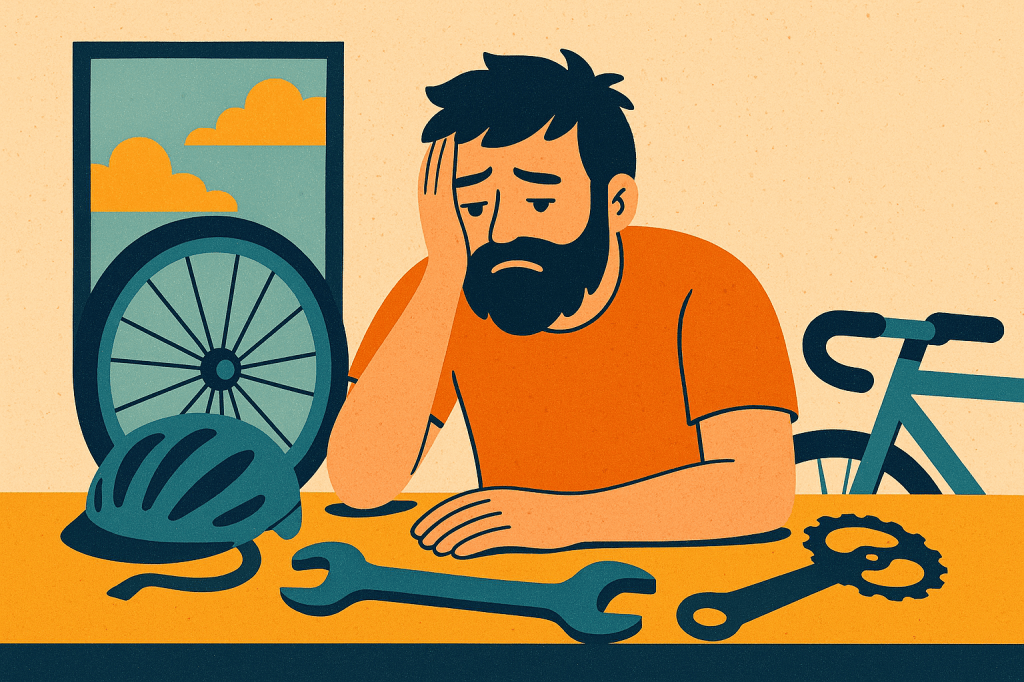
Tag: bike shop life

  • Burnout Looks a Lot Like Ambition From the Outside

    Burnout Looks a Lot Like Ambition From the Outside

    There’s a scene in the show Black Books where a customer is knocking on the door of the bookshop and Bernard, the owner, panics. He says something like, “Oh god, what do they want?” and his assistant, Manny, says, “They want to buy a book.” Bernard, with dead eyes, responds, “But why me? Why do they come to me?”

    That was me, running a bike shop.

    People would walk in, smiling, friendly, talking about the weather, and I would feel this simmering internal scream build in my chest because I knew they were about to ask me something I’d been asked five hundred times before. Something I had answered every summer for two decades, And I’d have to smile. And I’d have to sound helpful. And I’d have to be this guy who loved his job. 

    Because from the outside, I was living the dream.

    Own a bike shop, they said. Do what you love. Spend your days around bikes, talking about bikes, fixing bikes. Sounds incredible. 

    And it was incredible. For a while. Until it wasn’t. 

    Burnout doesn’t always look like collapse. Sometimes it looks like success. Sometimes it’s doing everything you set out to do and discovering that you hate every minute of it. Sometimes it’s being so tired and angry and broke that you start resenting the very people who are trying to keep your lights on. 

    I couldn’t show it. If I looked miserable, I might lose a customer. And if I lost too many customers, I couldn’t pay the bills, So I kept the act going. I was two people. The smiling mechanic with grease on his hands, and the guy silently asking, Why the hell are you coming to me? 

    The same thing happened in racing.

    I’m not built like a cyclist. I’m 6’5”, and even at my most fit, I was over 200 pounds. I looked like I should be guarding the paint in the NBA, not trying to climb up switchbacks with guys built like greyhounds. But I kept showing up. I kept grinding. I kept doing the training, even when the payoff was, at best, finishing mid-pack and feeling like I was going to throw up the rest of the weekend. 

    People thought it was impressive. Look at you, balancing work, racing, life. They saw ambition. What they didn’t see was the exhaustion. The resentment. The part of me that knew I wasn’t going to win but kept showing up anyway because I didn’t know how to stop without feeling like a failure. 

    Burnout and ambition wear the same clothes. They look like commitment. They look like hard work. But one of them fuels you and the other hollowed me out from the inside until I didn’t recognize the guy standing in my own shop. 

    Here’s the hard truth I learned too late: 

    No matter what you do, it eventually becomes your pain-in-the-ass job. 

    Even the things you love.

    Especially the things you love. 

    And the people who succeed? Half the time, they’re jus the ones who were too stubborn or too stupid to quit. I’ve been both. It works. Until it doesn’t. 

    If you’re out there grinding through your own “dream,” feeling miserable and confused about why it feels so wrong, maybe it’s not you. Maybe you’re just burned out and no one noticed because you still look productive. 

    I don’t have a perfect answer, but I do know this. If it feels like you’re drowning while everyone around you thinks you’re surfing, it’s okay to stop and ask whether the ocean you’re in still belongs to you.

  • Servant Leadership Isn’t About Being a Doormat, It’s About Being the Door

    Servant Leadership Isn’t About Being a Doormat, It’s About Being the Door

    Somewhere along the way, servant leadership picked up a reputation for being soft. Not thoughtful. Not strategic. Just soft. 

    People hear “servant” and picture someone running for coffee while everyone else gets to lead. Like the goal is to be so helpful that your own spine turns to Jello and your DMs become a dumping ground for everyone else’s problems. 

    That’s not servant leadership. It’s self-erasure with a to-do list. 

    When I was working on my Master’s, I ran into the same confusion. The term seemed cringe. It sounded like corporate double-speak for “do all of the emotional labor and never ask for a raise.” But then I read Leadership: Theory and Practice by Peter Northouse, and it started to make sense. The model isn’t about letting people walk all over you. It’s about helping them move forward without making yourself the center of every decision. 

    Servant leadership works because it’s built on actual accountability. You’re still responsible for the outcomes, you just don’t accomplish them by barking orders or hoarding control like a middle manager afraid of being replaced by someone with better time management and a decent pair of headphones. 

    Robert Greenleaf, who coined the term, said the real test of servant leadership is whether the people you’re leading grow. Not whether they hit their quarterly metrics or zero out their inbox. Whether they grow as people. That’s a hell of a bar, but it’s also the only one that matters if your leadership is supposed to mean anything after you’re gone. 

    When I owned a bike shop, I didn’t know Greenleaf from a bottom bracket. What I knew was that yelling never made a kid faster at fixing a flat, and micromanaging every tune-up left me too burnt out to deal with the stuff that actually mattered. So I taught. I handed people tools. I explained stuff once and then backed off. If they got it wrong, I coached. If they got it right, I said thank you and let them keep doing it. 

    I didn’t do that because I’m some visionary leader. I did it because it was the only way to make the chaos sustainable. It turns out that’s what servant leadership looks like in the wild. Not theory. Practice. 

    The same thing shows up behind the DM screen. You ever try to wedge your party through your genius three-act structure, only for them to adopt a stray grung, burn down your main plot hook, and spend an entire session trying to steal coins from innocent NPCs in a bar? That’s what happens when you treat leadership like control instead of support. 

    Good DMs build a world Great ones build a space where players feel like their decisions matter. They guide without choking the life out of the table. They create momentum, not mandates. 

    That’s servant leadership, too. 

    So no, it’s not about being a doormat, it’s about being the door. You dont get applause. You don’t get to be center stage. But you hold the frame. You let people move forward. And that matters. 

    If you’re leading because you want to be the smartest person in the room, servant leadership will frustrate the hell out of you. But if you’re in it to build people up and leave things better than you found them, then this is how you do it without turning yourself into a puddle of resentment and unpaid overtime. 

    And yeah, sometimes they forget to say thank you. Doors don’t get credit. 

    They just work.