

Tag: communication

  • Why Emotional Intelligence Is Basically the GM Screen of Real Life

    Why Emotional Intelligence Is Basically the GM Screen of Real Life

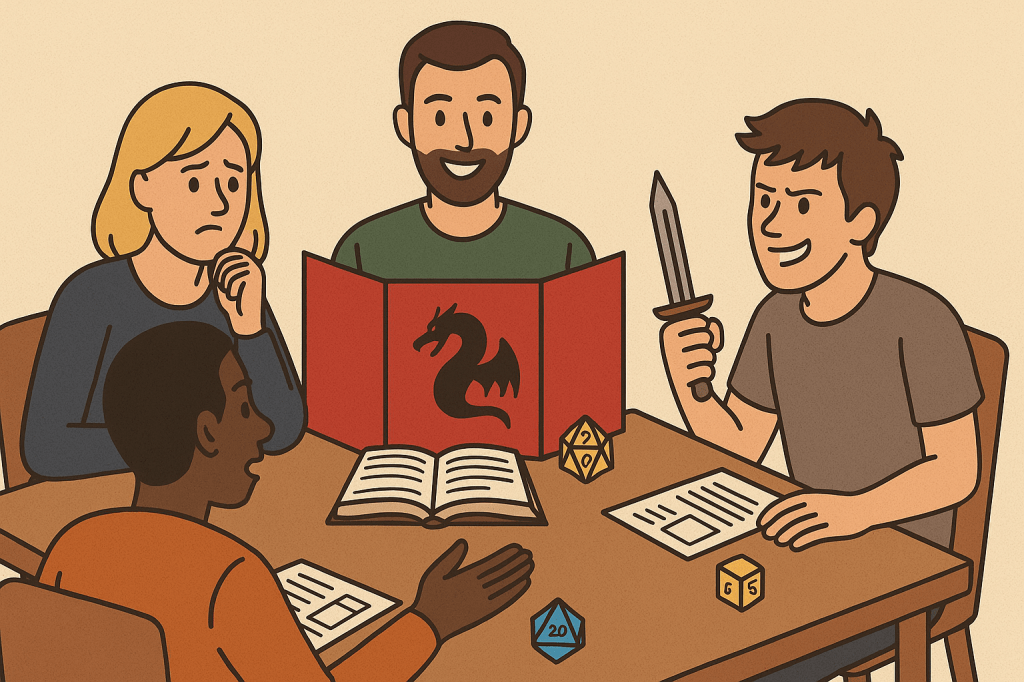
    Back when I first started GMing tabletop games, I thought the little cardboard screen was mostly there to hide my dice rolls when I fudged the numbers to keep the rogue from dying in a sewer. And yes, it did that job just fine. But over time, I realized the real power of that screen wasn’t secrecy—it was stability. The GM screen lets me manage perception. It let me project confidence even when I had absolutely no idea what I was doing. When the bard decided to barter with a dragon mid-combat and the plan somehow worked, the screen let me scramble silently while saying, “Interesting choice. Give me just a moment to calculate how that would work.” Behind the cardboard? Full panic. In front of it? Implacable dungeon master. That, my friends, is Emotional Intelligence.

    If you’ve ever been in charge of anything—whether it’s coordinating a crew of overcaffeinated delivery drivers or guiding your friends through a dungeon full of murder skeletons—you already know what it’s like to look serene on the outside while your brain is breakdancing through a five-alarm crisis. Emotional Intelligence, or EQ if you’re trying to sound fancy in a meeting, isn’t about shutting off your emotions like some kind of sociopathic vending machine. It’s about mastering the subtle art of emotional stagecraft: knowing which feelings to air out, which ones to fold up and tuck behind your metaphorical GM screen, and when to pull yourself together just long enough to keep the whole table from flipping over. Because let’s be honest—if you’re leading without Emotional Intelligence, it’s not a game anymore. It’s just trauma with dice.

    aniel Goleman—the guy who basically turned Emotional Intelligence into a bestselling brand—divides it into five domains: self-awareness, self-regulation, motivation, empathy, and social skills. Sounds tidy enough to fit on a poster in a corporate hallway next to a stock photo of people high-fiving in a wheat field. But here’s what most leadership books don’t tell you: nobody can see you doing any of this. There’s no glittery badge that lights up when you regulate your emotions or empathize correctly in a staff meeting. These skills operate in stealth mode. They live in the five-second pause after someone screws up and you’re deciding whether to guide them through the wreckage or launch into a “what the hell is wrong with you” monologue. Emotional Intelligence is like a hidden dice roll behind the GM screen—no one at the table sees the number, but they all feel whether you rolled a nat 20 or a critical fail based on what happens next.

    One of the coolest things Emotional Intelligence gives you is the ability to pause the movie before your brain hits the “yell and break things” button. It lets you choose your reaction instead of letting it choose you like some rage-filled claw machine. Back when I was still new to management and clinging to my systems like they were ancient scrolls of forbidden knowledge, one of my team members absolutely annihilated a process I’d spent weeks building. Not out of spite—just out of panic, pressure, and possibly a complete misunderstanding of how calendars work. The whole thing imploded and we lost an entire day’s worth of work. My gut reaction was the usual greatest hits: jaw clench, pulse spike, and a deep internal scream that translated to, “How?! Why?! What is wrong with you?!”

    But this is where EQ stepped in like the friend who quietly takes your drink away before you do something you’ll regret. I took a walk, breathed like a Buddhist monk who just sat on a Lego, and reminded myself that throwing a tantrum wouldn’t magically fix the inventory or make the team smarter. So I came back and said—calmly, somehow—“Walk me through this. I want to make sure we set you up better next time so this doesn’t feel like your only option.” That moment of controlled response didn’t just fix the process. It built trust. It said, “Yeah, you screwed up—but I’m not gonna throw you into the volcano for it.” And that quiet, invisible choice right there? That’s the kind of leadership that keeps the party from turning on each other and flipping the whole damn table.

    Now, some people hear “Emotional Intelligence” and think it’s just a fancy word for not showing weakness. The toxic version of that idea turns into the blank-faced, corporate manager archetype who says things like “Let’s circle back” and “Appreciate your candor” while privately fantasizing about rage-punching the break room fridge. But EQ isn’t about bottling everything up and sealing it with a smile. It’s about using emotion with intention. If someone drops the ball and you don’t feel even a flicker of frustration, congratulations—you’ve officially detached from reality. But the moment you let that frustration blast out like a busted fire hydrant, you’re not leading anymore. It’s not cathartic. It’s damaging. And once your players—sorry, I mean employees—realize your screen has holes, they start making decisions based on your volatility rather than your vision.

    This is the fork in the road where Emotional Intelligence separates actual leaders from people who just have the bigger desk. Because here’s the thing, your team isn’t a set of problems to be fixed—they’re a party of weird, unpredictable adventurers, each hauling around their own unique stats and baggage. You don’t get loyalty by being louder or squeezing harder. You don’t get trust by demanding it like a toddler screaming for snacks. You have to earn those things the hard way—by listening when it’s inconvenient, by managing your own emotional mess before cleaning up someone else’s, and by realizing that just because you feel something doesn’t mean it gets to grab the wheel. Feelings are passengers. You’re the one supposed to be steering.

    I once had a player who treated failure like a personal insult from the universe. If a plan fell apart, he’d slump in his chair, glare at the dice like they owed him money, and spend the next hour passive-aggressively dismantling the vibe. I had every excuse to boot him from the table or call him out in front of the group, but that would’ve been leadership in the same way a fire extinguisher is interior design. Instead, I remembered something from a leadership book that actually stuck: Emotional Intelligence lets you guide people without turning everything into a power struggle. So I pulled him aside and said, “Look, the dice aren’t out to get you. They’re just throwing curveballs. This is improv, not a performance review. Let’s figure out how to make the twist part of the story.” He didn’t suddenly become a model player, but he did start seeing the GM screen as a boundary—not a battleground. That’s the job. Leadership isn’t about proving how right you are. It’s about steering the ship through the storm without convincing the crew they’re all going to drown.

    And make no mistake: your plan will fall apart. Leadership is improv. It’s crisis management. It’s trying to guide a group of people toward a shared goal when everyone has a different idea of what that goal should look like—and someone keeps trying to seduce the dragon. Emotional Intelligence doesn’t make you immune to stress, it just keeps you from turning that stress into shrapnel.

    So if you’re in charge and find yourself saying, “I’m just being real,” or “They need to toughen up,” take a second and ask: who’s actually behind the screen right now—the leader who sees the group’s needs and responds accordingly or the panicked goblin in your head that’s slapping at the controls, trying not to lose control? 

    Because the screen isn’t there to block out your humanity—it’s there to keep you from flinging it around like a live grenade.

  • The Most Toxic Alignment at the Table: Chaotic Selfish

    The Most Toxic Alignment at the Table: Chaotic Selfish

    There’s a certain kind of player who shows up to your game table and, within five minutes, makes it clear that they’re “Chaotic Neutral.” Not just in character sheet alignment, but in the very marrow of their bones. You can smell it on them like Axe body spray and misplaced confidence. They say it with a grin, usually while licking a dagger or attempting to steal from the party’s healer. They believe this gives them permission to act entirely on impulse, with no consideration for the rest of the group or the broader story. They will gleefully derail entire plot arcs, antagonize NPCs for no reason, betray the party for a shiny trinket, and defend it all with one sacred phrase: “I’m just playing my character.”

    And if you’re lucky, they’ll do it before you’ve printed everyone’s Session Zero handouts.

    Now, let’s not misunderstand the assignment. Chaotic Neutral as an alignment isn’t inherently broken. In fact, when played with nuance, it can be one of the most textured roles at the table. These characters are wild cards, but they should still have values—they might reject laws, but not consequences; they might be unpredictable, but not purposeless. The problem is that, more often than not, what we’re dealing with isn’t Chaotic Neutral. It’s something much worse: Chaotic Selfish. It’s a player who confuses impulsiveness with entitlement. A player who believes that because they have chosen to act like a gremlin, the group is now obligated to revolve around that behavior or risk “ruining the fun.” It’s not a character flaw they’ve built into their backstory—it’s a leadership vacuum they’ve dragged in from real life.

    This is where the leadership lesson kicks in with a steel-toed boot. Every GM is a de facto leader, whether they asked for it or not. You’re not just managing a story—you’re managing a group of people, each of whom has different motivations, energy levels, social cues, and expectations about what a “fun” game night looks like. And one of the most insidious leadership traps you’ll fall into is thinking that everyone in the group is here to play the same game. They’re not. One player might want a deep character arc and emotional growth. Another is here to unwind after work by punching ghosts. A third thinks they’re auditioning for Critical Role, and a fourth just wants to do math with fireballs. If your Chaotic Selfish player isn’t corrected early, they will fracture that group like a bad manager who mistakes “disruption” for innovation.

    Because here’s the uncomfortable truth most leadership books won’t tell you: not all conflict is healthy. Yes, diversity of thought is valuable. Yes, challenging the status quo can drive innovation. But when someone insists on setting fires inside the team dynamic just to watch what happens, they’re not challenging assumptions—they’re demanding attention. And when leaders tolerate that behavior under the banner of “freedom,” they’re not being inclusive; they’re abandoning the rest of the team to fend for themselves. If you’ve ever worked with someone who constantly interrupts meetings with off-topic jokes, undercuts colleagues with passive-aggressive remarks, or ignores deadlines because they “work best under pressure,” you’ve already met this person. You just called them Carl from marketing instead of Zorkas the Knife-Licker.

    The problem gets worse because many GMs, like many new managers, are conflict-avoidant. They don’t want to “ruin the vibe.” They want to be liked. And so they let the behavior slide, justifying it as flavor or roleplay. After all, isn’t the point of a tabletop RPG to allow people to do things they can’t do in real life? Sure. But there’s a difference between a fantasy of power and a fantasy of lack of consequences. One is healthy escapism; the other is what you get when you let someone live out their worst impulses in a sandbox with no boundaries. You don’t have to let it slide. You shouldn’t. Good leadership doesn’t mean letting everyone do whatever they want. It means setting a culture where everyone can thrive, not just the loudest person with a backstory written in blood.

    If you need a scholarly anchor to hang your GM screen on, let’s talk about transformational leadership, the kind that focuses on inspiring and guiding individuals toward a shared vision. Bernard Bass (1990) outlined the four components: idealized influence, inspirational motivation, intellectual stimulation, and individualized consideration. If your “chaotic” player is stifling any one of those pillars, your leadership mandate is clear—they need coaching, redirection, or, in some rare cases, a one-way ticket out of the campaign. When someone makes the game unplayable for others, that is a leadership problem, not a roleplay quirk. Letting it fester because “that’s just how they are” is the same as letting a team member steamroll meetings because “they’re just passionate.” No—they’re just inconsiderate. And inconsiderate people don’t improve by being enabled.

    There’s a reason most TTRPG safety tools—like The X-Card—exist in the first place: because the social contract of the table is fragile. Most of us are awkward nerds with damage and anxiety and jobs we’re trying to escape for three hours on a Thursday. The emotional risk of collaborative storytelling is real. So when someone shows up determined to be the unpredictable gremlin who pees in the soup and blames the character sheet, what they’re really doing is violating that social contract—and trusting you, the GM, not to call them on it.

    So call them on it.

    Do it early, do it privately, and do it with the same calm confidence you’d use to tell someone they forgot deodorant. Be direct: “I want to make sure this game is fun for everyone, and I’ve noticed that some of your character’s actions are making that harder. Can we talk about ways to channel that chaotic energy without disrupting the table?” That’s not confrontation. That’s leadership. That’s you refusing to let one person ruin a shared experience because they don’t know the difference between playing a complex character and throwing a tantrum with dice.

    Look, no group is perfect. And no GM is either. You’re going to make mistakes. You’re going to let stuff slide that you shouldn’t, or come down hard when you should’ve asked a question instead. That’s the job. That’s why they call it “running” a game—you’re always in motion, always responding, always adjusting. But you don’t have to do it with a party member standing on the roof of the tavern, throwing Molotov cocktails into your narrative because they thought it would be funny. You don’t have to let selfishness wear the mask of alignment.

    Chaotic Neutral doesn’t have to mean chaos without care. It can mean unpredictability with purpose. It can mean wildness tempered by curiosity. And most importantly, it can mean a table where everyone—not just the loudest—gets to be the main character in their own little story.

  • Radical Honesty Sounds Great Until You Actually Try It

    Radical Honesty Sounds Great Until You Actually Try It

    You’ve probably seen the phrase “radical honesty” floating around in TED Talks, thought leader newsletters, or stitched onto decorative pillows sold by entrepreneurs who post five-minute clips of themselves walking through their neighborhoods at 6 a.m. It sounds brave. Disruptive. Empowering. 

    But here’s the thing. Radical honesty feels great when you’re the one saying it. It’s a lot less fun when you have to live with it. 

    Because honesty isn’t just about blurting out whatever you think. That’s not honesty. That’s social arson. Leadership honesty–the kind that actually works–is about being accountable to the truth, even when it’s inconvenient, even when it costs you something, and even when you really want to dodge it with a little strategic word salad. 

    When I Ran a Bike Shop, Honesty Wasn’t a Brand. It Was a Liability.

    Back when I owned a bike shop, I couldn’t bring myself to lie to a customer. Not about the quality of a product, not about how much they needed something, not even about their cracked carbon frame that definitely wasn’t “just like that when I got it.”

    This wasn’t because I’m especially noble. It was just because I’d rather lose a sale than lose sleep over it. I turned down commissions. I steered people toward cheaper items that worked just as well. I never pushed brands I didn’t believe in, even when reps dangled incentives in front of me like a meatball sub in front of a hungry dog. 

    That got me a reputation for being “honest but blunt,” a few angry internet reviews from people who didn’t like hearing the truth, and a lot of customers who kept coming back because they knew I wasn’t full of it. 

    There’s research backing this up. A University of Chicago Booth School of Business study found that individuals consistently underestimated how positively others respond to honesty, especially when delivering truths that are hard to hear. Across experiments, asking participants to speak honestly for a few days or give blunt feedback, the findings showed that honesty was far more pleasant and socially connective than people had predicted. 

    That doesn’t mean that honesty always feels good in the moment. But it does build trust

    What It Looks Like in Leadership–and In RPGs

    Let’s take a break from the workplace for a second and talk about tabletop roleplaying games. If you’ve ever been a Game Master, you already understand leadership in its purest, least compensated form. You are the final authority on what’s true in that world. 

    When your players ask, “Does the guard look nervous?” they aren’t just testing your improvisational skills–they’re testing whether the world reacts in a way that feels real. If everything always breaks in their favor, they’ll know the fix is in. If nothing ever does, they’ll stop trying.

    Good GMs–and good leaders–understand that the job isn’t about making things easy. It’s about making things clear. Clarity creates trust. Consistency builds momentum. Honesty creates a space where people can actually do something useful instead of wasting all their energy trying to decode your mixed signals. 

    That applies whether you’re managing three warehouse employees who treat the breakroom microwave like a performance art piece or running a team of elven rogues and bard college dropouts. 

    Honesty Isn’t a Hammer–It’s a Compass

    One of the most common misuses of honesty in leadership is treating it like a hammer. “I’m just being honest,” says the manager as they whack a team member with a barely filtered complaint. That’s not honesty. That’s emotional outsourcing. 

    Real honesty is a compass. It keeps you oriented, even when the terrain sucks. 

    It’s saying, “I missed something during planning, and that’s why we’re behind schedule,” instead of, “We’ve had to make some pivots to align with evolving priorities.” It’s acknowledging when someone’s right, even if you feel insecure. It’s telling someone they’re falling short and offering them a path to improvement, dropping that truth bomb and moonwalking out the door. 

    This is the principle behind Kim Scott’s concept of Radical Candor, which encourages leaders to “care personally while challenging directly.” It’s a balance between honesty and empathy–between clarity and cruelty. 

    And it works because it’s sustainable. People can tell the difference between a leader who’s being transparent to avoid manipulation and one who’s just looking for an excuse to say whatever’s on their mind without consequences. 

    Honesty Means Letting the Bad News Be Real

    One of the hardest parts about being honest as a leader is accepting that sometimes, the bad news just sucks. There’s no silver lining, no spin, no nifty metaphor that’s going to make the metrics look better or the budget any less wrecked. 

    And in those moments, people don’t need you to inspire them. They need you to acknowledge reality. They need to see you take responsibility.

    For another take on why avoiding clarity isn’t kindness, check out this Forbes piece, “Why Leaders Are Ditching the ‘Nice Boss’ Approach,” which argues that stepping away from vague reassurance toward honest communication actually builds stronger, more engaged teams. 

    Here’s the Real Trick: They’ll Start Doing It Too

    Once people see you modeling this kind of honesty–not performative honesty, but the kind that actually costs you something–they start to feel safe doing it, too. They admit when they’re confused. They speak up sooner. They stop hiding behind half-truths and start engaging like they’re actually on the same team. 

    That’s how culture changes. Not through posters in the hallway or all-hands pep talks. Through consistent, exhausting, thankless moments of being honest when it would be so much easier not to be. 

    You don’t need to tell everyone everything all the time. But if you’re not telling the truth, they’ll know. And once that trust is gone, it doesn’t come back with a company picnic.

    Whether you’re rolling dice behind a screen or making calls on the warehouse floor, honesty isn’t a luxury. It’s your north star. And following it isn’t always comfortable. But it’s the only way anyone gets anywhere worth going.