
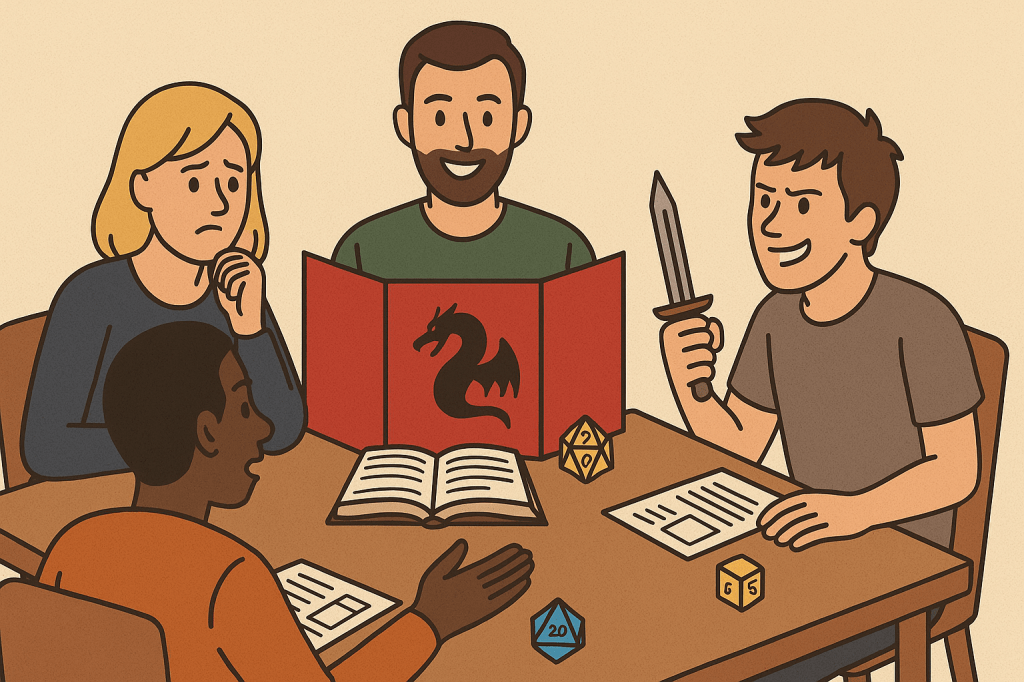
There’s a certain kind of player who shows up to your game table and, within five minutes, makes it clear that they’re “Chaotic Neutral.” Not just in character sheet alignment, but in the very marrow of their bones. You can smell it on them like Axe body spray and misplaced confidence. They say it with a grin, usually while licking a dagger or attempting to steal from the party’s healer. They believe this gives them permission to act entirely on impulse, with no consideration for the rest of the group or the broader story. They will gleefully derail entire plot arcs, antagonize NPCs for no reason, betray the party for a shiny trinket, and defend it all with one sacred phrase: “I’m just playing my character.”
And if you’re lucky, they’ll do it before you’ve printed everyone’s Session Zero handouts.
Now, let’s not misunderstand the assignment. Chaotic Neutral as an alignment isn’t inherently broken. In fact, when played with nuance, it can be one of the most textured roles at the table. These characters are wild cards, but they should still have values—they might reject laws, but not consequences; they might be unpredictable, but not purposeless. The problem is that, more often than not, what we’re dealing with isn’t Chaotic Neutral. It’s something much worse: Chaotic Selfish. It’s a player who confuses impulsiveness with entitlement. A player who believes that because they have chosen to act like a gremlin, the group is now obligated to revolve around that behavior or risk “ruining the fun.” It’s not a character flaw they’ve built into their backstory—it’s a leadership vacuum they’ve dragged in from real life.
This is where the leadership lesson kicks in with a steel-toed boot. Every GM is a de facto leader, whether they asked for it or not. You’re not just managing a story—you’re managing a group of people, each of whom has different motivations, energy levels, social cues, and expectations about what a “fun” game night looks like. And one of the most insidious leadership traps you’ll fall into is thinking that everyone in the group is here to play the same game. They’re not. One player might want a deep character arc and emotional growth. Another is here to unwind after work by punching ghosts. A third thinks they’re auditioning for Critical Role, and a fourth just wants to do math with fireballs. If your Chaotic Selfish player isn’t corrected early, they will fracture that group like a bad manager who mistakes “disruption” for innovation.
Because here’s the uncomfortable truth most leadership books won’t tell you: not all conflict is healthy. Yes, diversity of thought is valuable. Yes, challenging the status quo can drive innovation. But when someone insists on setting fires inside the team dynamic just to watch what happens, they’re not challenging assumptions—they’re demanding attention. And when leaders tolerate that behavior under the banner of “freedom,” they’re not being inclusive; they’re abandoning the rest of the team to fend for themselves. If you’ve ever worked with someone who constantly interrupts meetings with off-topic jokes, undercuts colleagues with passive-aggressive remarks, or ignores deadlines because they “work best under pressure,” you’ve already met this person. You just called them Carl from marketing instead of Zorkas the Knife-Licker.
The problem gets worse because many GMs, like many new managers, are conflict-avoidant. They don’t want to “ruin the vibe.” They want to be liked. And so they let the behavior slide, justifying it as flavor or roleplay. After all, isn’t the point of a tabletop RPG to allow people to do things they can’t do in real life? Sure. But there’s a difference between a fantasy of power and a fantasy of lack of consequences. One is healthy escapism; the other is what you get when you let someone live out their worst impulses in a sandbox with no boundaries. You don’t have to let it slide. You shouldn’t. Good leadership doesn’t mean letting everyone do whatever they want. It means setting a culture where everyone can thrive, not just the loudest person with a backstory written in blood.
If you need a scholarly anchor to hang your GM screen on, let’s talk about transformational leadership, the kind that focuses on inspiring and guiding individuals toward a shared vision. Bernard Bass (1990) outlined the four components: idealized influence, inspirational motivation, intellectual stimulation, and individualized consideration. If your “chaotic” player is stifling any one of those pillars, your leadership mandate is clear—they need coaching, redirection, or, in some rare cases, a one-way ticket out of the campaign. When someone makes the game unplayable for others, that is a leadership problem, not a roleplay quirk. Letting it fester because “that’s just how they are” is the same as letting a team member steamroll meetings because “they’re just passionate.” No—they’re just inconsiderate. And inconsiderate people don’t improve by being enabled.
There’s a reason most TTRPG safety tools—like The X-Card—exist in the first place: because the social contract of the table is fragile. Most of us are awkward nerds with damage and anxiety and jobs we’re trying to escape for three hours on a Thursday. The emotional risk of collaborative storytelling is real. So when someone shows up determined to be the unpredictable gremlin who pees in the soup and blames the character sheet, what they’re really doing is violating that social contract—and trusting you, the GM, not to call them on it.
So call them on it.
Do it early, do it privately, and do it with the same calm confidence you’d use to tell someone they forgot deodorant. Be direct: “I want to make sure this game is fun for everyone, and I’ve noticed that some of your character’s actions are making that harder. Can we talk about ways to channel that chaotic energy without disrupting the table?” That’s not confrontation. That’s leadership. That’s you refusing to let one person ruin a shared experience because they don’t know the difference between playing a complex character and throwing a tantrum with dice.
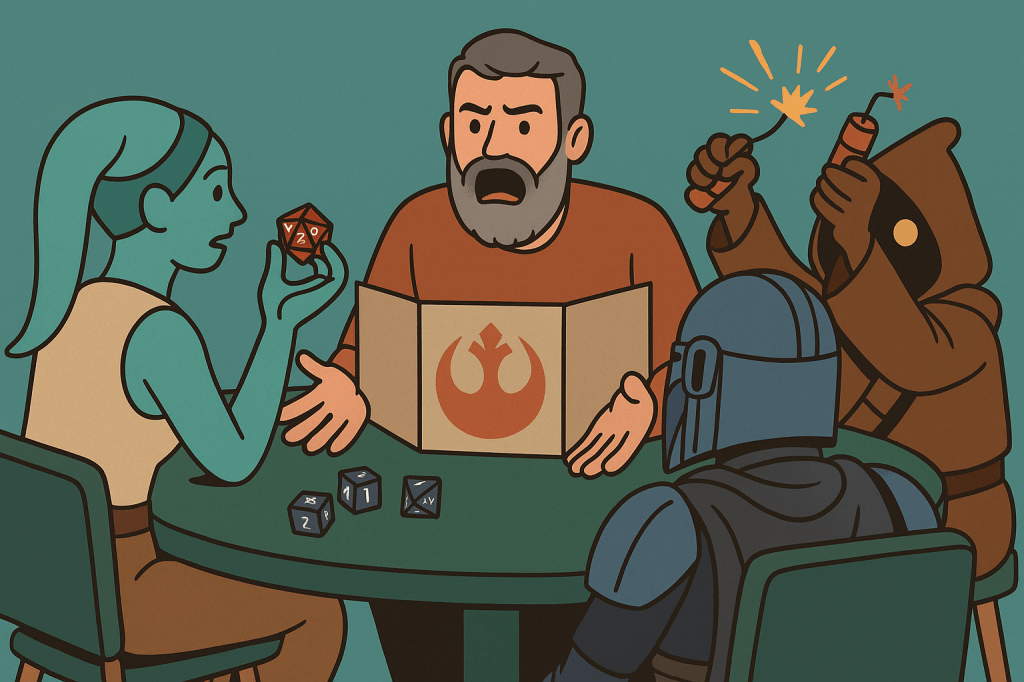
Look, no group is perfect. And no GM is either. You’re going to make mistakes. You’re going to let stuff slide that you shouldn’t, or come down hard when you should’ve asked a question instead. That’s the job. That’s why they call it “running” a game—you’re always in motion, always responding, always adjusting. But you don’t have to do it with a party member standing on the roof of the tavern, throwing Molotov cocktails into your narrative because they thought it would be funny. You don’t have to let selfishness wear the mask of alignment.
Chaotic Neutral doesn’t have to mean chaos without care. It can mean unpredictability with purpose. It can mean wildness tempered by curiosity. And most importantly, it can mean a table where everyone—not just the loudest—gets to be the main character in their own little story.
 Roll For Insight