
Tag: tabletop rpgs

  • The Rules Changed, But We Just Forgot to Tell You

    The Rules Changed, But We Just Forgot to Tell You

    Nothing makes people question your leadership faster than realizing the finish line they’ve been running toward just got picked up and moved. This is the organizational version of telling a kid they can have dessert if they finish their vegetables, then halfway through the broccoli deciding they also need to clean the garage and mow the lawn first. The dessert was never the point. The goal was to keep them occupied until you could figure out how to get out of your own chores.

    In corporate life, this usually shows up when leadership makes a promise they didn’t fully think through. The intent might have even been noble at first — “Hey, we’ll make sure everyone gets a fair shot at promotion.” But when the sign-up sheet fills faster than expected and the people who actually have to conduct those evaluations start sweating about their workload, suddenly there’s a brand-new hoop to jump through. A leadership assessment. A timed test. An extra round of manager sign-off. And here’s the kicker: fail that extra hoop and you don’t just miss your shot — you don’t even get told what you did wrong, so you can fix it next time.

    From the outside, this reads less like “streamlining the process” and more like “we realized how much work this would be for us, so we invented a filter to thin the herd.” There’s no transparency, no feedback, and no sense that the people in charge remember they promised you something in the first place. Which brings us to the real damage: it’s not the inconvenience that kills morale. It’s the unspoken message that your leadership’s word is provisional. Conditional. Entirely dependent on whether it still suits them to keep it.

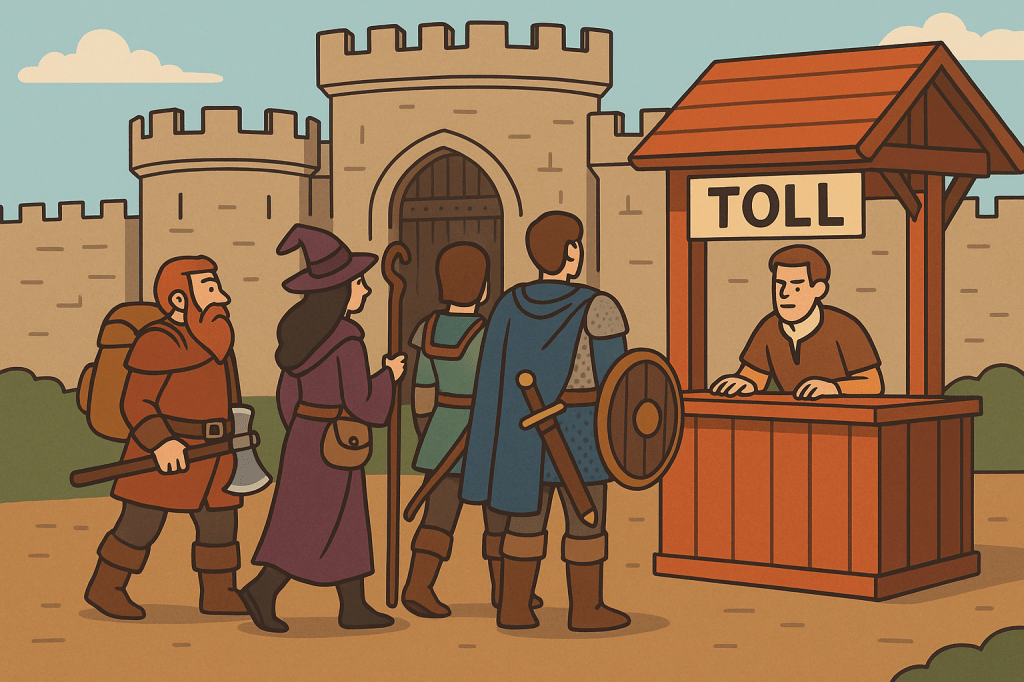
    If you’ve ever run a game of D&D, you know exactly how this plays out. You tell your group that if they defeat the Big Bad Evil Guy, they’ll hit Level 10. This is the campaign’s driving goal. Every plan, every detour, every questionable alliance with shady NPCs is about gearing up for that final fight. Then, right before the big showdown, you say, “Actually, before you can fight him, you’ll need to pass this riddle challenge. Fail, and you can’t try again until next year. Oh, and I won’t tell you what answers you got wrong.” At best, the players feel blindsided. At worst, they start suspecting you never really wanted them to succeed in the first place. And once players stop trusting their GM, the game stops being fun. They’ll still show up — sunk-cost fallacy is a hell of a drug — but the spark’s gone.

    And here’s where leadership theory has been screaming warnings for decades. In transformational leadership, one of the core jobs of a leader is to inspire people toward a shared vision through consistency, trust, and integrity (Bass, 1990). If the vision changes, you bring your team along for the why, the how, and the what’s-next. But if you just quietly rewrite the playbook mid-season without telling anyone, you’ve broken what Rousseau (1995) calls the psychological contract — that unspoken agreement between leader and team about what each side owes the other. Once that’s broken, even the most committed, high-performing people start conserving their energy. Not out of spite, but out of survival. They’ve learned the rules can change without warning, so why go all-in?

    There’s a way to fix this without torching morale, but it requires humility and a little bit of courage. If you truly can’t honor the original path you laid out — whether because of volume, budget, or your own failure to anticipate demand — transparency is your only way out. Spell out what’s changing, why it’s changing, and how people can still succeed under the new system. Give feedback, even if it’s just “You scored lower on decision-making under time pressure — here’s where to practice.” If you have to thin the candidate pool, do it in a way that still respects the original promise, even if it means spreading things out over a longer timeline. Otherwise, you’re just selecting for the people most willing to tolerate frustration, which is not the same as selecting for the people most capable of leading.

    The rules can change — life’s unpredictable, and leadership is about adapting. But if you want your people to keep showing up with full effort, the one rule that can’t change is this: when you say something matters, it has to keep mattering, even when it’s inconvenient for you.

    References:

    Bass, B. M. (1990). From transactional to transformational leadership: Learning to share the vision. Organizational Dynamics, 18(3), 19–31.

    Rousseau, D. M. (1995). Psychological contracts in organizations: Understanding written and unwritten agreements. Sage Publications.

  • You Don’t Need to Know Everything—Just Stop Faking It

    There’s a particular kind of boss that’s worse than just a micromanager. It’s the kind who micromanages badly—hovering over tasks they don’t actually understand, second-guessing decisions with no context, inserting themselves into workflows like a toddler grabbing the steering wheel from the backseat. At least a competent micromanager might know what they’re interrupting. But this flavor of leader doesn’t know the work, won’t admit it, and compensates by managing through vague questions, performative stress, and ominous calendar invites titled “Touch Base.” If you’ve never had a boss like that, congratulations on your peaceful life. The rest of us are still flinching every time someone asks if we “have a minute.”

    I’ve worked under those managers, and—cards on the table—I’ve been one, too. Not in the mustache-twirling villain sense, but in the more common and less cinematic way: I got put in charge of something I didn’t totally understand, so I backed off too far because I didn’t want to come across like a dumbass. That’s the inverse version of the same mistake. Instead of meddling, I ghosted. I figured giving people space was the respectful thing to do, when what they actually needed was presence. Not command. Not control. Just the sense that I was there, paying attention, invested, and ready to help.

    Running a team without understanding their work is like Game Mastering a system you’ve never read. You might be able to fake it for a session or two. Maybe you’ve got the vibe down—narrating like Matt Mercer on half-speed, throwing in enough “roll for initiative” moments to keep everyone entertained. But sooner or later, your players are going to do something mechanical. They’ll try to shove a goblin off a bridge, or cast a spell that interacts with a system you didn’t prep, or—God help you—start asking about grappling rules. And now you’re scrambling through the Player’s Handbook like it’s a cursed tome, bluffing your way through it while everyone quietly starts texting under the table. Because nothing kills trust like a GM who pretends to know things they clearly don’t.

    Leadership theory has a name for this balancing act: Situational Leadership. Hersey and Blanchard laid it out in the late ’60s, but the idea still hits. It says your leadership style should adapt based on how competent and confident your team is at a given task. Some people need direction. Others need support. Some just need you to get out of the way and let them work. But the only way to figure that out is to actually know where they’re at. And that requires something micromanagers and absentee leaders alike tend to skip: asking questions and listening to the answers.

    Most micromanagers don’t think they’re micromanaging. They think they’re doing due diligence. Staying informed. “Driving results.” But what they’re actually doing is disrupting Self-Determination Theory—a cornerstone of motivation research that says people thrive when they feel autonomous, competent, and connected. Micromanaging undercuts autonomy. But if you also don’t know the work, it undercuts competence too—yours and theirs. You’re not just in the way; you’re actively creating friction, the same way a GM does when they override the bard’s plan just because they didn’t understand how Bardic Inspiration stacks.

    And on the flip side, disappearing because you don’t understand the work doesn’t help either. That just makes people feel unsupported, especially when things start going sideways. It’s the equivalent of a GM saying, “Well, that’s what your character would do,” and then zoning out on their phone while the players roleplay around them. Sure, you’re not interrupting, but you’re also not engaged. You’ve become the leadership version of ambient tavern music.

    So how do you do it better?

    You get curious. You name what you don’t know. You ask your team what they need from you today, not just what they needed when the project started. You ask, “What am I doing that’s helpful?” and brace yourself for the silence that might follow. You sit with it. Then you try again.

    You stop treating questions like traps and start using them like torches. You stop assuming that being “the boss” means you have to be the expert. And you realize that your credibility doesn’t come from having all the answers—it comes from helping the people who do their best work.

    If you’re running a campaign and you don’t know every mechanic, that’s fine. But don’t fake it. Bring in a co-GM, hand off to someone more familiar with the system, or prep more next time. In the moment, the best thing you can do is own it. Say, “I don’t actually know how this rule works—can you walk me through it?” And suddenly, you’ve transformed from an authority figure faking competence into a leader modeling collaboration.

    When you’re a leader and you don’t know the work, your job isn’t to disappear. And it’s not to overcorrect by smothering your team with bad advice. Your job is to learn just enough to be useful, to ask the right questions, and to create an environment where people feel like they can do their thing without you pretending to be the expert on everything. Because when people know you’ve got their back—not their keyboard—that’s when trust actually starts to build.

    And the next time you do have to give direction, it won’t sound like interference. It’ll sound like support.


    Citations:

    Deci, E.L., & Ryan, R.M. (2000). The “what” and “why” of goal pursuits: Human needs and the self-determination of behavior. Psychological Inquiry, 11(4), 227–268.

    Hersey, P., & Blanchard, K.H. (1969). Life cycle theory of leadership. Training & Development Journal, 23(5), 26–34.

  • Why Emotional Intelligence Is Basically the GM Screen of Real Life

    Why Emotional Intelligence Is Basically the GM Screen of Real Life

    Back when I first started GMing tabletop games, I thought the little cardboard screen was mostly there to hide my dice rolls when I fudged the numbers to keep the rogue from dying in a sewer. And yes, it did that job just fine. But over time, I realized the real power of that screen wasn’t secrecy—it was stability. The GM screen lets me manage perception. It let me project confidence even when I had absolutely no idea what I was doing. When the bard decided to barter with a dragon mid-combat and the plan somehow worked, the screen let me scramble silently while saying, “Interesting choice. Give me just a moment to calculate how that would work.” Behind the cardboard? Full panic. In front of it? Implacable dungeon master. That, my friends, is Emotional Intelligence.

    If you’ve ever been in charge of anything—whether it’s coordinating a crew of overcaffeinated delivery drivers or guiding your friends through a dungeon full of murder skeletons—you already know what it’s like to look serene on the outside while your brain is breakdancing through a five-alarm crisis. Emotional Intelligence, or EQ if you’re trying to sound fancy in a meeting, isn’t about shutting off your emotions like some kind of sociopathic vending machine. It’s about mastering the subtle art of emotional stagecraft: knowing which feelings to air out, which ones to fold up and tuck behind your metaphorical GM screen, and when to pull yourself together just long enough to keep the whole table from flipping over. Because let’s be honest—if you’re leading without Emotional Intelligence, it’s not a game anymore. It’s just trauma with dice.

    aniel Goleman—the guy who basically turned Emotional Intelligence into a bestselling brand—divides it into five domains: self-awareness, self-regulation, motivation, empathy, and social skills. Sounds tidy enough to fit on a poster in a corporate hallway next to a stock photo of people high-fiving in a wheat field. But here’s what most leadership books don’t tell you: nobody can see you doing any of this. There’s no glittery badge that lights up when you regulate your emotions or empathize correctly in a staff meeting. These skills operate in stealth mode. They live in the five-second pause after someone screws up and you’re deciding whether to guide them through the wreckage or launch into a “what the hell is wrong with you” monologue. Emotional Intelligence is like a hidden dice roll behind the GM screen—no one at the table sees the number, but they all feel whether you rolled a nat 20 or a critical fail based on what happens next.

    One of the coolest things Emotional Intelligence gives you is the ability to pause the movie before your brain hits the “yell and break things” button. It lets you choose your reaction instead of letting it choose you like some rage-filled claw machine. Back when I was still new to management and clinging to my systems like they were ancient scrolls of forbidden knowledge, one of my team members absolutely annihilated a process I’d spent weeks building. Not out of spite—just out of panic, pressure, and possibly a complete misunderstanding of how calendars work. The whole thing imploded and we lost an entire day’s worth of work. My gut reaction was the usual greatest hits: jaw clench, pulse spike, and a deep internal scream that translated to, “How?! Why?! What is wrong with you?!”

    But this is where EQ stepped in like the friend who quietly takes your drink away before you do something you’ll regret. I took a walk, breathed like a Buddhist monk who just sat on a Lego, and reminded myself that throwing a tantrum wouldn’t magically fix the inventory or make the team smarter. So I came back and said—calmly, somehow—“Walk me through this. I want to make sure we set you up better next time so this doesn’t feel like your only option.” That moment of controlled response didn’t just fix the process. It built trust. It said, “Yeah, you screwed up—but I’m not gonna throw you into the volcano for it.” And that quiet, invisible choice right there? That’s the kind of leadership that keeps the party from turning on each other and flipping the whole damn table.

    Now, some people hear “Emotional Intelligence” and think it’s just a fancy word for not showing weakness. The toxic version of that idea turns into the blank-faced, corporate manager archetype who says things like “Let’s circle back” and “Appreciate your candor” while privately fantasizing about rage-punching the break room fridge. But EQ isn’t about bottling everything up and sealing it with a smile. It’s about using emotion with intention. If someone drops the ball and you don’t feel even a flicker of frustration, congratulations—you’ve officially detached from reality. But the moment you let that frustration blast out like a busted fire hydrant, you’re not leading anymore. It’s not cathartic. It’s damaging. And once your players—sorry, I mean employees—realize your screen has holes, they start making decisions based on your volatility rather than your vision.

    This is the fork in the road where Emotional Intelligence separates actual leaders from people who just have the bigger desk. Because here’s the thing, your team isn’t a set of problems to be fixed—they’re a party of weird, unpredictable adventurers, each hauling around their own unique stats and baggage. You don’t get loyalty by being louder or squeezing harder. You don’t get trust by demanding it like a toddler screaming for snacks. You have to earn those things the hard way—by listening when it’s inconvenient, by managing your own emotional mess before cleaning up someone else’s, and by realizing that just because you feel something doesn’t mean it gets to grab the wheel. Feelings are passengers. You’re the one supposed to be steering.

    I once had a player who treated failure like a personal insult from the universe. If a plan fell apart, he’d slump in his chair, glare at the dice like they owed him money, and spend the next hour passive-aggressively dismantling the vibe. I had every excuse to boot him from the table or call him out in front of the group, but that would’ve been leadership in the same way a fire extinguisher is interior design. Instead, I remembered something from a leadership book that actually stuck: Emotional Intelligence lets you guide people without turning everything into a power struggle. So I pulled him aside and said, “Look, the dice aren’t out to get you. They’re just throwing curveballs. This is improv, not a performance review. Let’s figure out how to make the twist part of the story.” He didn’t suddenly become a model player, but he did start seeing the GM screen as a boundary—not a battleground. That’s the job. Leadership isn’t about proving how right you are. It’s about steering the ship through the storm without convincing the crew they’re all going to drown.

    And make no mistake: your plan will fall apart. Leadership is improv. It’s crisis management. It’s trying to guide a group of people toward a shared goal when everyone has a different idea of what that goal should look like—and someone keeps trying to seduce the dragon. Emotional Intelligence doesn’t make you immune to stress, it just keeps you from turning that stress into shrapnel.

    So if you’re in charge and find yourself saying, “I’m just being real,” or “They need to toughen up,” take a second and ask: who’s actually behind the screen right now—the leader who sees the group’s needs and responds accordingly or the panicked goblin in your head that’s slapping at the controls, trying not to lose control? 

    Because the screen isn’t there to block out your humanity—it’s there to keep you from flinging it around like a live grenade.

  • What RPGs Taught Me About Managing Difficult People (That HR Never Will)

    What RPGs Taught Me About Managing Difficult People (That HR Never Will)

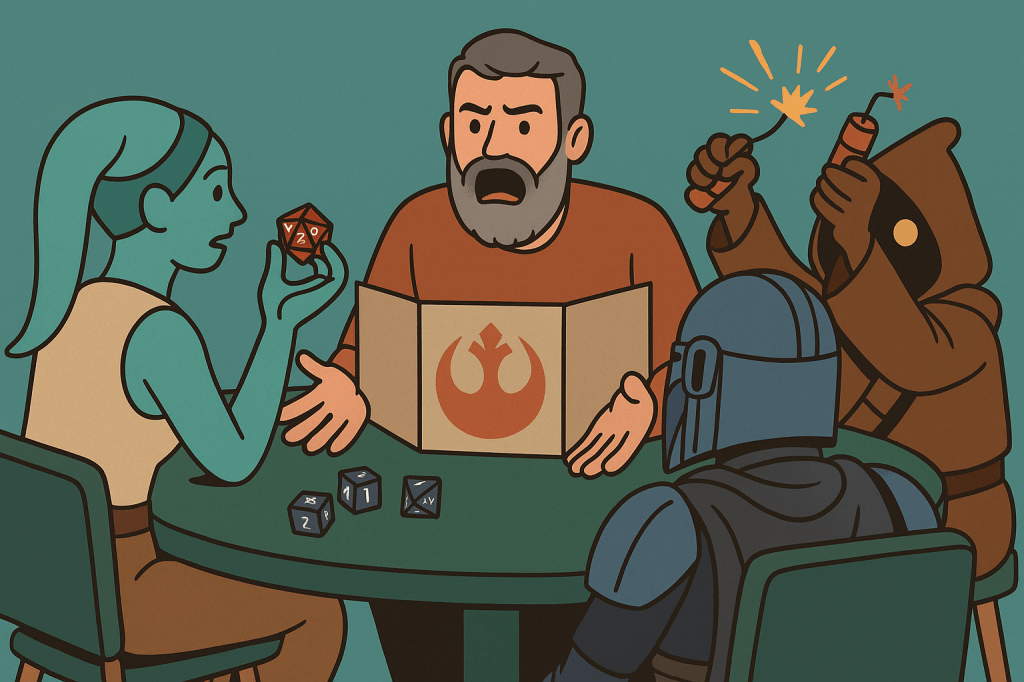
    Back when I used to run a Star Wars RPG campaign, we had a player whose character was a Jawa demolitionist. If you’ve never played with one of those, imagine a three-foot-tall raccoon with access to military-grade explosives and absolutely zero impulse control. 

    At first, it was hilarious. He’d drop a thermal detonator into an Imperial outpost ventilation shaft and walk away whistling. Chaotic? Yes. Effective? Surprisingly. Until it wasn’t. 

    One session, the group had finally managed to track down a high-ranking informant hiding out in a cantina. This was a culmination of weeks of game effort. Negotiation. Intel gathering. Actual diplomacy. The party was nervous but optimistic. They walked in ready to talk. 

    The Jawa rolled a perception check, decided he “didn’t like the bartender’s vibe” and threw a thermal detinator into the kitchen. 

    The session went to hell immediately. The informant was killed in the blast. The building collapsed. Half the party had to burn Destiny Points to avoid dying. And the rest of the session devolved into stunned silence and awkward laughter. The kind where people aren’t sure whether to stay in character or pack up and go home. 

    Afterward, I pulled the player aside. 

    I asked if he could tone it down a bit. Not stop being fun or unpredictable, but maybe dial back the random violence, just a notch. Maybe make sure the rest of the group gets to do something before everything explodes. 

    He didn’t take it well.

    He accused me of limiting his creativity and said I was punishing him for roleplaying. He told me that the rest of the group should adapt if they “weren’t on his level.” 

    And there it was. The moment every leader eventually faces. 

    The person who brings energy, ideas and unpredictability, but in a way that derails the team. The person who isn’t bad at what they do, but bad for the group doing it together

    I’ve worked with that Jawa before. Not just at the table, but on actual teams. The coworker who goes rogue on projects without telling anyone. The manger who launches half-baked initiatives and lets everyone else clean up the fallout. The “rock star” who gets praised for bold ideas while leaving collaboration in ruins. 

    Leading that kind of person is hard because they usually mean well. They think they’re helping. They think the group is holding them back. They think the rules are for less brilliant people. 

    And that’s what HR doesn’t tell you. 

    They’ll give you frameworks for communication. Feedback tools. Mediation strategies. But they rarely talk about what happens when someone just likes the chaos. When their motivation isn’t growth, it’s chaos. 

    Eventually, we wrote the Jawa out of the game. Not because he was evil, but because the rest of the group stopped having fun. The sessions became less about story and more about damage control. And that’s when I knew I’d made the right call. 

    Leadership isn’t about keeping everyone happy. It’s about protecting the space where the team can actually work.

    Sometimes, that means asking someone to step back. Sometimes it means rewriting the party dynamic. And sometimes, it means telling a three-foot-tall demolitionist to take his bombs and roll for retirement.